


Like many of you, I enjoy seeing what my friends and family members are up to. Staying current on new additions to the family, weddings, vacations to cool places, football games and concerts prompts me to text a quick hello or “I’ve missed talking with you!” Sometimes, I’ll even pick up the phone and actually call. When used thoughtfully, social media can actually enhance our lives. It helps us stay connected with friends and family, discover new ideas, and even spark creative inspiration. In moderation, it can boost our sense of belonging and give us quick access to meaningful professional insights and conversations.
But like many things that are beneficial in small doses—sunlight, caffeine, even work itself—too much exposure can have the opposite effect. Overuse of social media can quietly chip away at our focus, self-esteem, empathy, and even our real-world relationships. When we leave our mental “aperture” wide open all the time, we let in so much input that our brains can’t process it effectively. The result is often emotional exhaustion, confusion, and a creeping sense that we’re falling behind or not good enough. I know because it’s happened to me.
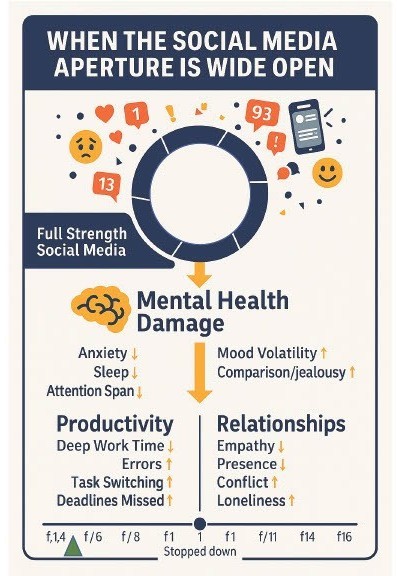
Mini Self-Check: Is Social Media Doing You More Harm Than Good
Answer *yes* or *no* to each:
- I often find myself scrolling even when I intended to do something else.
- I sometimes feel anxious, frustrated, or angry after spending time on social media.
- I compare my life or achievements to others online and feel worse as a result.
- I lose track of time when I’m online, leading to less focus or productivity at work.
- I’ve noticed myself reacting more harshly or impatiently toward people with different opinions.
- I’ve skipped face-to-face interactions or meaningful activities because I was online instead.
If you answered “yes” to three or more, it may be time to close the aperture a little. Reducing your daily exposure—even by 20–30 minutes—can help you regain clarity, energy, and emotional balance.
As a culture, we’ve become more digitally connected than ever, but also more distracted and polarized. That’s one reason our Connecting with Respect training program focuses on rebuilding the habits of curiosity, listening, and empathy—skills that tend to erode when our online interactions reward quick reactions instead of thoughtful reflection.
So try an experiment this week: set a daily limit, turn off a few notifications, or take one full day away from social media. Notice how your focus sharpens, your productivity goes up, and your interactions—both at work and at home—feel more authentic.
Sometimes, the best way to see the world clearly again is simply to narrow the aperture, limiting our intake of noise and chatter from a fractious social media ecosphere. This creates more space for us to focus on the people, goals, and causes that truly are important.

ABOUT PAUL MESHANKO
Paul Meshanko is an author, professional speaker and business leader with over 20 years of experience in leadership development and organizational culture change. After a 12-year career with AlliedSignal, he opened Legacy Business Cultures in 1997 to serve the Nation’s growing demand for innovative and proven strategies for creating best in class workplace cultures. Paul specializes in change management and employee engagement training, diversity and inclusion training, executive coaching and organizational assessments. Under his leadership, the business has grown to become one of the most successful boutique talent and development providers in the country.